Tichu Rules Explained — Combinations, Special Cards, Tichu Calls, and Scoring
Tichu is, in a word, "the game of shedding the cards in your hand before everyone else." Four players sit down, the people facing each other form a team, and the team that collects more points wins. Think of it as a combination card game like poker, with plenty of teamwork and bluffing thrown in.
This article walks through everything in order, from the cards to combinations, special cards, Tichu calls, and scoring, so that even a first-timer can play a full game.
One-line summary: Four players in two teams of two try to shed their hands before everyone else, and the first team to collect 1000 points wins.
The flow at a glance
1. You receive 8 cards and decide whether to call Grand Tichu.
2. You receive the remaining 6 cards, making 14, and exchange one card with each of the other three players.
3. The player holding the Mah Jong starts playing cards. Players are ranked 1st, 2nd, and 3rd in the order they empty their hands.
4. When three players have gone out, the round ends and points are counted.
5. Rounds repeat until one team reaches 1000 points.
56 cards, and four of them are the stars
The regular cards are 52 cards: four suits (spades, hearts, diamonds, clubs) from 2 to Ace. Four special cards are added, and these four are what make the game Tichu.
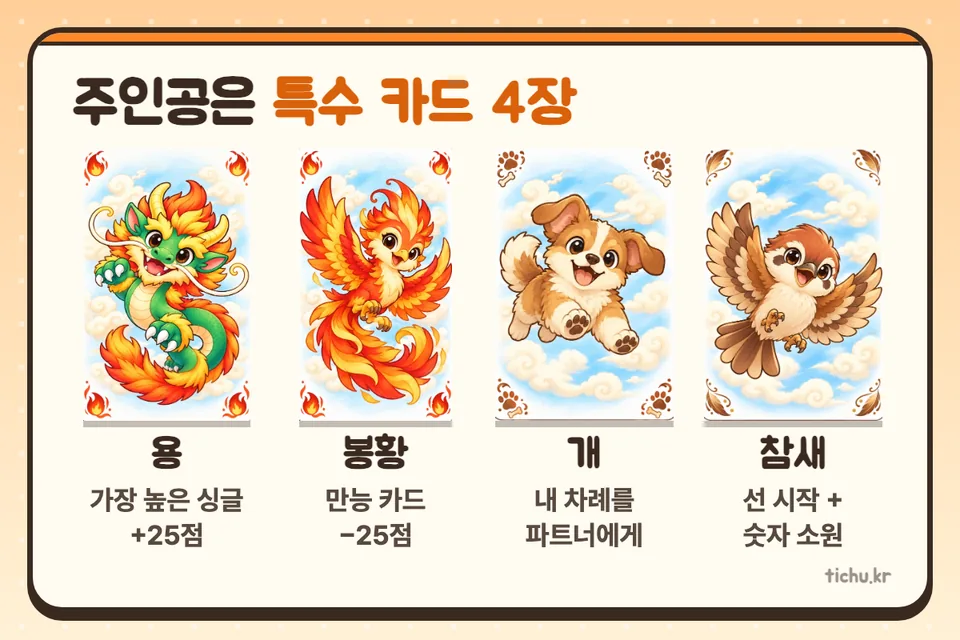
Mah Jong (1)
The lowest card, with the number 1. The player holding the Mah Jong makes the first lead of the round. When playing it, you can make a wish. If you say "I want to see a 7," then anyone who can play a combination containing a 7 afterward must play it. It is a card that quietly makes things awkward for your opponents. You don't have to make a wish. The Mah Jong can be used as a 1 in a straight of 5 or more cards.
Dog
A card that can only be played on the lead (at the very front). When you play the Dog, your turn passes to your partner. You can't win with it alone, but it is very reassuring when you want to hand over the game with "partner, take it from here!" Because the Dog produces no trick to win, it cannot be cut by a bomb, and it can't be mixed into other combinations either. If your partner has already gone out, the lead passes to the next player.
Phoenix
The shapeshifter. Within a combination, it stands in for any number you want. It fills the one missing card in a pair, triple, full house, straight, or consecutive pairs. Played alone, it has a value 0.5 higher than the previous card. (So it can't beat the Dragon.) When played alone on the lead, it is treated as the weakest card. It cannot be used in a bomb. In points it is worth −25, so using it carelessly costs your team points. The more you use it, the more it hurts to lose.
Dragon
The highest single card. Only a bomb can beat the Dragon. It is worth +25 points, but there is a price: a trick won with the Dragon must be given to one of the opposing players. You decide which of the two opponents gets it. Just holding a 25-point card feels good, but remember that all the points piled up in that trick can pass to the opponents too.
Step 1: Receiving cards and Grand Tichu
At first you receive only 8 cards. Looking at just these 8, declaring in advance "I'll go out first!" is the Grand Tichu. Once everyone has chosen, you receive the remaining 6 cards.
- Success (you go out first) → +200 points
- Failure → −200 points
Even veterans feel their hearts pound at this moment. To be confident about going out first from only 8 cards, you need several powerful cards such as the Dragon or bombs.
Step 2: Exchange
Once you have 14 cards, you pass one card each face down to the other three players. You give one card each to the player on your left, your partner, and the player on your right, so you give three cards and receive three.
The basic strategy is to give good cards to your partner and weak cards to your opponents. The charm of this step is that you must read each other's minds without saying a word to your partner. (And sometimes you completely misunderstand each other.)
Tichu call
After seeing all 14 cards, before you play your first card, if you feel confident that "with this hand I'll go out first," you can call Tichu.
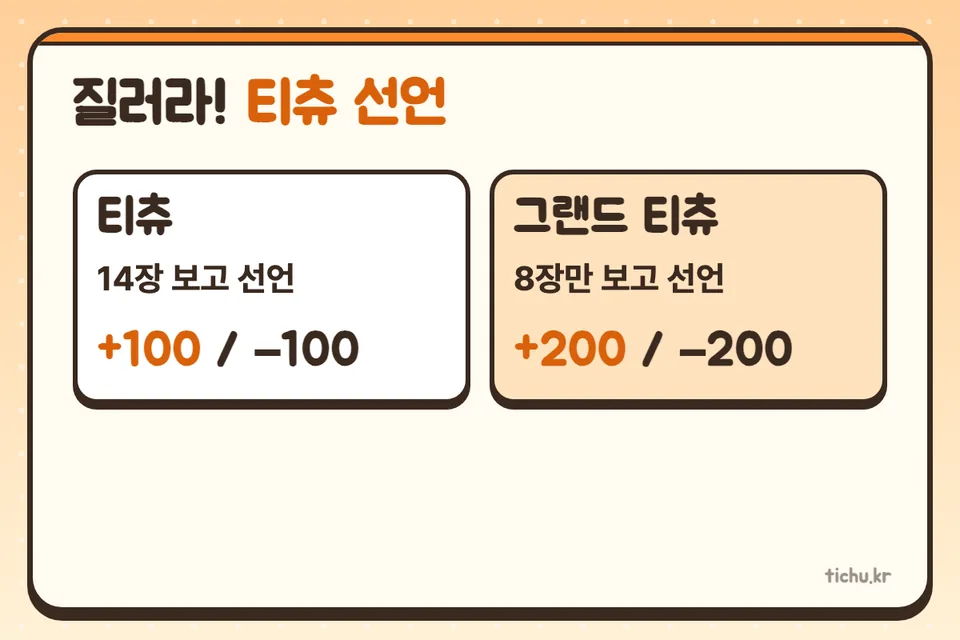
- Success (you go out first) → +100 points
- Failure → −100 points
A player who has already called Grand Tichu cannot call Tichu again. If you are confident, go for it; if not, just pray that your partner calls it for you. Both players on a team can make calls, and each call is reflected in the score separately.
Step 3: Playing cards
When someone plays cards, the following players either play a higher combination of the same type and same number of cards or pass. A single must be answered with a single, a pair with a pair, and a five-card straight with a five-card straight. The player on the lead (at the very front) can play any combination, and cannot pass on the lead.
When everyone passes, the player who played the last cards takes that trick, becomes the lead again, and starts anew.
Playable combinations
- Single — one card.
- Pair — two cards of the same number.
- Triple — three cards of the same number.
- Full house — one triple and one pair, 5 cards in all. It is ranked by the number of the triple.
- Straight — 5 or more cards of consecutive numbers. The Mah Jong can be used as a 1, and the Ace is the highest.
- Consecutive pairs — two or more pairs of consecutive numbers bundled together (for example, 8-8-9-9).
The Phoenix can stand in for the one missing card in these combinations. The Dog and the Dragon cannot be mixed into combinations.
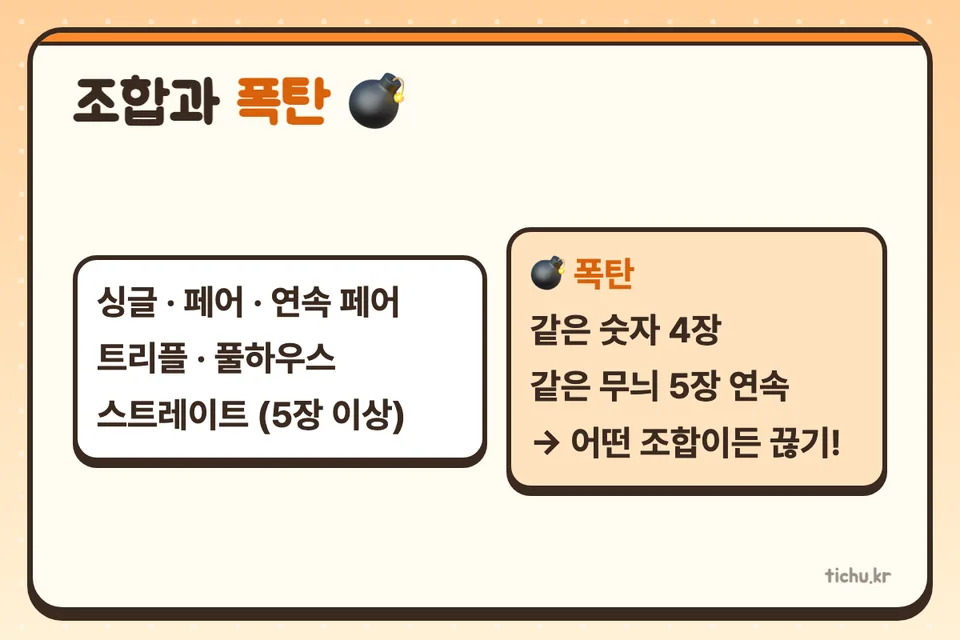
Bombs
The special combination that cuts through every other combination is the bomb.
- Four-of-a-kind bomb — 4 cards of the same number.
- Straight flush bomb — 5 or more consecutive cards of the same suit.
A bomb beats any combination, and it can be played even when it isn't your turn. The thrill of cutting down, in one blow, a run your opponent worked hard to build is truly hard to put into words. Among bombs, a straight flush is stronger than four of a kind; among straight flushes, the longer one wins, and if they are the same length the higher one wins; among four-of-a-kind bombs, the higher number wins. The Phoenix cannot be used in a bomb, and the Dog cannot be cut by a bomb.
The wish rule
If the owner of the Mah Jong made a wish, anyone who can play that number must play it. However, if you could play it but cannot win that trick, you have no obligation. Once the wish is fulfilled, its effect disappears.
When does a round end?
Players are ranked 1st, 2nd, and 3rd in the order they empty their hands, and when 3 players have gone out, the last remaining player automatically finishes last. If one team takes both 1st and 2nd place, the round ends immediately.
How is the score counted?
Only a few cards carry points.
- 5 — 5 points
- 10 — 10 points
- K — 10 points
- Dragon — +25 points
- Phoenix — −25 points
- All other cards are worth 0 points
The points at stake in one round add up to 100 points in total.
Normal counting
Each team adds up the card points from the tricks its players won. However, the last-place player gets special treatment.
- The cards in the tricks the last-place player won go to the team of the 1st-place player.
- The points of the cards the last-place player still holds go to the opposing team.
So holding point cards until the very end costs you twice over.
One-two finish
If one team takes both 1st and 2nd place, it is called a one-two, and that team takes 200 points outright, with no card counting. When this happens the whole round flips at once, so if you see the opposing team heading for a one-two, everyone has to try desperately to stop it.
Adding Tichu points
The success or failure of Tichu and Grand Tichu is added or subtracted separately from the card points.
- Example: your team won 60 points in cards, and one of your players called Tichu and went out first → 60 + 100 = 160 points.
- In the same situation, if the Tichu caller did not go out first → 60 − 100 = −40 points.
- If you got a one-two and your team's 1st-place player had called Tichu → 200 + 100 = 300 points.
End of the game
By default, the first team to reach 1000 points wins. If both teams pass the target with the same score, play continues until a winner is decided.
Tips for beginners
- Don't use the Dragon and Phoenix too early. It's best to save the Dragon for when you are sure to take the lead, and the Phoenix for when you need to complete a run or a full house.
- If your partner has called Tichu, the basics of teamwork is to clear the way so that player can go out.
- If an opponent has called Tichu, keep a bomb in hand and set it off at the last moment.
- Save the Dog. It is most valuable at the decisive moment when you need to hand the lead to your partner.
- The Mah Jong wish is a tool for tormenting your opponents. Pick a number you think they are holding and that you can block.
- Aim for a one-two, or block one. 200 points can change the course of a whole game.
Common mistakes
- Throwing point cards (5, 10, K) into a trick your opponent is going to win.
- Not choosing carefully who to give the trick to after winning with the Dragon.
- Setting off a bomb too early and being unable to use it at the truly important moment.
- Finishing last while stuck holding lots of point cards.
Frequently asked questions
How many people play Tichu? Four. It is a 2-vs-2 team game. On Tichu Online, bots fill the empty seats if there aren't enough players.
What is the difference between Tichu and Grand Tichu? Grand Tichu is called after seeing only the first 8 cards, while Tichu is called after seeing all 14 cards. The points at stake also differ: 200 points and 100 points.
How do I use the Phoenix? Within a combination it stands in for any number you want, and played alone it has a value 0.5 higher than the previous card. Its score is −25, so it is a card you would rather let your opponents take if possible.
What happens to the points when I win with the Dragon? You must give the trick you won to one of the opposing players. In return, since the Dragon card is worth 25 points, those points go along with it.
When can I play the Dog? Only on the lead, and playing it passes the lead to your partner.
Can I play a bomb at any time? In a trick where cards have already been played, you can play one even when it isn't your turn. The Dog cannot be cut by a bomb.
What is a one-two finish? It is when one team takes both 1st and 2nd place. That team takes 200 points regardless of the card points.
How many points do I need to win? By default, the first team to reach 1000 points wins.
Can I practice online? At https://tichu.kr you can practice with bots or play against friends right away, with no installation. There are also Android and iOS apps.
🎮 Play Tichu nowNo install needed — play right in your browser. Other games: Mighty · Skull King · Love Letter
© Tichu Online · Support