Skull King Rules Explained — Bids, Special Cards, Scoring and Expansions
The core rule of Skull King fits in one sentence: "Win exactly as many tricks as you said you would." If you said you would win three tricks this round, you must win exactly three to score. Two won't do, and neither will four. Winning a lot is not the goal, so you constantly face moments where you have to hold back from winning, or lose on purpose. That irony is what makes it addictive.
It plays with 2 to 6 players, so it is great when your group size is awkward, and it is an individual game where everyone competes on their own with no teams. This guide walks through the rules in order so that even first-timers can play a full game.
One-line summary: you only score if you win exactly as many tricks as you bid. Winning a lot is not the goal.
The game at a glance
A game lasts 10 rounds. In round 1 you get one card, in round 2 two cards, and so on, up to ten cards in round 10. A round goes like this.
1. You are dealt your cards.
2. Everyone simultaneously bids how many tricks they will win this round. 0 is allowed.
3. You play one card at a time and fight over the tricks. You play as many tricks as the number of cards you were dealt.
4. When the round ends, you compare your bid with what actually happened and calculate the score.
When the 10 rounds are over, the player with the highest total score wins.
Getting to know the cards
The standard deck has 66 cards: 52 number cards and 14 special cards.
Number cards
There are four suits, yellow, green, purple and black, each numbered 1 to 13. Of these, black is the trump suit. If even one black card appears in a trick, black wins, no matter how high the other suits are.
Special cards
- Escape (5 cards): a getaway. It is a card that can't beat anyone. It is a savior for someone who bid to win 0 tricks.
- Pirate (5 cards): beats every number card. If several Pirates are played, the Pirate played first wins.
- Mermaid (2 cards): stronger than number cards, but gets captured by a Pirate. However, the Mermaid has a trump card up her sleeve. She is the only card that can capture the Skull King.
- Skull King (1 card): beats almost every card, Pirates included. Everything except the Mermaid.
- Tigress (1 card): when you play it, you can choose to use it as a Pirate or as an Escape. It can transform to suit the situation, so it is very versatile.

The circle of capture
The key to the special cards is this cycle of three.
- The Skull King captures the Pirate.
- The Pirate captures the Mermaid.
- The Mermaid captures the Skull King.

What happens if the Skull King, a Mermaid and a Pirate are all played in one trick? In that case, the Mermaid wins. The rule that the Mermaid captures the Skull King is applied first. It is the same no matter how many Pirates are played.
Bidding
When a round begins, everyone makes their bid simultaneously. You can say anything from 0 up to the number of cards you were dealt this round. In round 1 that is 0 or 1; in round 5 you choose from 0 to 5.
The bid is everything in this game. If you hold Pirates and the Skull King, it looks like you can win many tricks, but you have to win exactly that many and no more. Conversely, even with only weak cards, a bid of 0, where you have to lose on purpose, is fairly safe and worth a lot of points.
Playing cards
The player to the dealer's left starts the first trick. The dealer moves one seat each round. After that, whoever won the previous trick plays first.
Following suit
When the leader plays a number card, its suit becomes the lead suit. If you have a number card of the lead suit in your hand, you must play that suit or play a special card. Only when you have no card of the lead suit can you play any card. This is also the only time you can play black (trump).
Here are a few situations that tend to cause confusion.
- You can play a special card at any time. Even if you hold a card of the lead suit, you can play a Pirate or an Escape.
- If the leader played an Escape first, the first number card played after that decides the lead suit.
- If the leader plays a Pirate, Mermaid or Skull King, there is no lead suit. Even if number cards are played afterward, no lead suit is created. Everyone can play any card.
The Tigress is decided when played
When you play the Tigress, you must decide whether to play it as a Pirate or as an Escape. The effect applies as you decided. Also remember that if you played it as a Pirate, it counts as one Pirate when the Skull King captures it.
Who wins the trick
Once everyone has played a card around the table, the winner is decided in the order below.
1. If a Mermaid and the Skull King were played together: the Mermaid wins (the first Mermaid played).
2. If the Skull King was played: the Skull King wins.
3. If a Pirate was played: the first Pirate played wins.
4. If a Mermaid was played: the first Mermaid played wins.
5. If only number cards were played: the highest black (trump) card wins. If there is no black, the highest card of the lead suit wins.
6. If everything is an Escape: the player who played first wins.
An Escape never wins in any situation, and it has no effect on the order in which tricks are won.
Scoring
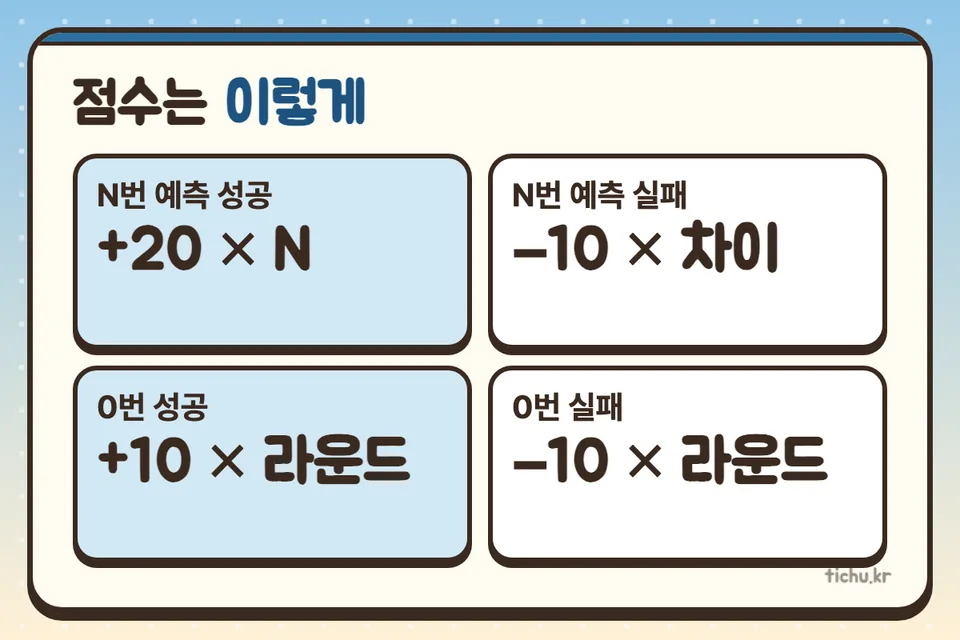
It depends on whether your bid was right or wrong.
When you bid 1 or more
- If you hit it exactly: the number of tricks you bid × 20 points. If you bid three and won three, that is 60 points.
- If you miss: you lose the difference between your bid and the actual number × 10 points. If you bid three but won five, that is −20 points; if you won only two, it is −10 points.
When you bid 0
The size of the score depends on the round number.
- If you win no tricks at all: you get the round number × 10 points. Hitting 0 in round 7 gives +70 points.
- If you win even one trick: you lose the round number × 10 points. If you accidentally win one in round 7, that is −70 points.
A bid of 0 in the late rounds is all or nothing, with a jackpot and a disaster both on the line.
Bonus points
There are bonuses you can receive only when you hit your bid exactly. If you miss, the bonus disappears too.
- When the Skull King captures Pirates: +30 points for each captured Pirate. A Tigress played as a Pirate counts too.
- When a Mermaid captures the Skull King: +50 points. It is a signature moment that can turn the whole game around.
Examples
- Round 5, bid 2, actual 2 → 20 × 2 = +40 points
- Round 5, bid 2, actual 3 → difference 1 × 10 = −10 points
- Round 7, bid 0, actual 0 → 7 × 10 = +70 points
- Round 7, bid 0, actual 1 → −70 points
- Round 4, bid 1, actual 1, and the Skull King captured two Pirates in that one trick → 20 + 30 × 2 = +80 points
- Round 4, bid 1, actual 1, and a Mermaid captured the Skull King in that one trick → 20 + 50 = +70 points
Making it more fun: expansion cards
Once you are comfortable with the basic rules, you can turn on expansion cards in the room settings.
Kraken
The sea monster makes this entire trick void. Nobody wins the trick, and neither the win count nor bonuses are counted. The next trick is started by the player who would have won if the Kraken had not been played.
White Whale
It cancels the effect of every special card. In this trick only number cards count, and the highest number wins regardless of suit. Black (trump) no longer has any privilege. If no number card was played at all, the trick is void, and the player who played the White Whale leads next.
If the Kraken and the White Whale appear in the same trick, only the effect of the one played later applies. The one played earlier is treated like an Escape.
Loot
The player who played Loot and the player who won that trick form an alliance. If both of them hit their bids when the round ends, each receives +20 points per Loot card. If even one of them misses their bid, neither gets anything. Loot is not a winning card, so there is a fun side to it: players who have to lose on purpose even after playing Loot join hands.
Pirate-ability mode
When this mode is on, each of the five Pirates gets its own name and unique ability. If you win a trick with a named Pirate card, you can use its ability. (If you win with a Tigress played as a Pirate, there is no ability.)
- Rascal: wager 0, 10 or 20 points. If you hit your bid when the round ends, you receive the wagered points on top; if you miss, you lose that many.
- Rosie: choose anyone, yourself included, to start the next trick.
- Bent: take 2 cards from the pile left over after dealing, then discard any 2 cards from your hand.
- Harry: change your bid by +1 or −1, or leave it as it is. This is the only ability you can use even after the last trick.
- Juanita: look at the pile left over after dealing, by yourself.
Tips for beginners
Bid conservatively
- In the early rounds, don't be greedy: aim to hit your bid for sure. Rounds 1 to 3 have few cards, so bidding is easy, and if you bank some safe points here, the late rounds will be more comfortable.
- First count your cards that are sure to win, such as Pirates and the Skull King, and bid roughly that number plus a few high black number cards.
- If you hold an Escape, a bid of 0 is fairly safe. An Escape is a card that can never win.
Tips for bidding 0
- If you are holding low number cards and Escapes, it is worth going for 0.
- A 0 in the late rounds is worth a lot of points, but if you win even one trick you lose a lot. If you have a high card in your hand, first figure out whether there is a timing at which you can play it without winning.
How to use special cards
- Unleash the Skull King in a trick where many Pirates seem likely to appear, and the bonus is big.
- Keep the Mermaid hidden and unleash her all at once when it looks like the Skull King is coming out. The +50 points changes the mood of the whole round.
- The first Pirate played wins. If you don't want to win, use it when you are in a position to play late.
- If you save the Tigress until the very end, you can use it whether you want to win or want to lose, which makes it the most flexible card.
Common mistakes
- Trying to win too much. To hit your bid, you often have to lose on purpose.
- Forgetting the lead suit rule. If the leader plays a Pirate or the Skull King, there is no lead suit, so the players after can play freely.
- Forgetting that the Mermaid beats the Skull King. Many players trust the Skull King to win and get caught by a Mermaid.
- Going for a bonus and missing your bid. You can only receive a bonus if your bid is right.
Frequently asked questions
How many players does Skull King take? 2 to 6. If you are short of players, the bots in Tichu Online fill the empty seats.
How many rounds are there? 10 rounds. In round N, you are dealt N cards.
How many points do I lose for a wrong bid? The difference between your bid and the actual number of tricks × 10 points. If you fail a bid of 0, you lose the round number × 10 points.
Is it true that the Mermaid beats the Skull King? Yes. The Mermaid is the only card that can capture the Skull King, and capturing gives you a +50 point bonus too. However, you only receive it when you hit your bid exactly.
Who wins if the Skull King, a Mermaid and a Pirate are all played in one trick? The Mermaid wins. The rule that the Mermaid captures the Skull King is applied first.
Who wins the trick if only Escapes are played? The player who played first wins.
What kind of card is the Tigress? It is a card you can choose to use as a Pirate or as an Escape when you play it.
Do I have to follow the lead suit with special cards? No. Special cards can be played at any time.
How is a bid of 0 scored? If you win no tricks, you receive the round number × 10 points; if you win even one, you lose the same amount.
Do I have to use the expansion cards? No. The Kraken, White Whale, Loot and pirate-ability mode can be turned on in the room settings only when you want them.
Can I play online? You can start right away in your browser at https://tichu.kr with no installation. There are Android and iOS apps too.
🎮 Play Skull King nowNo install needed — play right in your browser. Other games: Tichu · Mighty · Love Letter
© Tichu Online · Support